GRAPHIC ERA (DEEMED TO BE UNIVERSITY), DEHRADUN
SEMESTER III
|
Sr. No. |
Department of Electronics and Communication Engineering |
||||||||
|
1. |
Subject Code |
TEC 343 |
Course Title |
Electronics Engineering Materials |
|||||
|
2. |
Contact Hours |
L |
3 |
T |
0 |
P |
0 |
||
|
3. |
Examination Duration |
Theory |
03 |
Practical |
0 |
||||
|
4. |
Relative Weight |
CIE |
25 |
MSE |
25 |
ESE |
50 |
||
|
6. |
Credit |
03 |
|||||||
|
6. |
Semester |
Three |
|||||||
|
7. |
Category of Course |
DSE/PEC |
|||||||
|
8. |
Pre-requisite |
Physics, Basic Electronics Engineering (TEC 101/201) |
|||||||
|
9. |
Course Outcomes |
After completion of the course the students will be able to: CO1: Understanding of crystallinity of electronic materials. CO2: Ability to develop free electron concept in various types of electronic materials. CO3: Develop the concept of optoelectronic and dielectric properties of the materials. CO4: Explanation of magnetic behaviour of electronic materials. CO5: Discuss the capacitive, resistive, and superconductivity of the material. CO6: Application of material in electronic devices according to their properties |
10. Details of the Course
|
Sl. No. |
Contents |
Contact Hours |
|
1. |
Unit 1: Crystal Structure: Crystalline state, bravais lattices, Miller indices, reciprocal lattice, common crystal structures, interference phenomenon, Bragg’s diffraction, crystal imperfections. |
9 |
|
2. |
Unit 2: Free Electron Theory: Conduction in metals and alloys, conductors, Semiconductors and resistors, Growth of single crystals, zone refining technique. Semiconductor properties and their applications. |
9 |
|
3. |
Unit 3: Optoelectronics and Dielectric Materials: Electric and optical properties, polarization in static and alternating field, piezoelectricity, polarizability and dielectric constant, optical transition in solids, absorption and emission of radiation. |
9 |
|
4. |
Unit 4: Magnetism: Magnetic properties of materials, diamagnetism, para-magnetism, ferromagnetism, black well, domain dimensions, anti-ferromagnetism, and ferromagnetism, ferrites, Magnetic Materials: Fe, Si, Ni, Co, Hard magnetic materials. |
10 |
|
5. |
Unit 5: Superconducting Materials: Materials for resistors, capacitors and inductors, properties and application of plastic materials, Superconductivity and superconductors. |
8 |
|
|
Total |
45 |
11. Suggested Books
|
SL. No. |
Name of Authors/Books/Publishers |
Edition |
Year of Publication / Reprint |
|
|
Textbooks |
|
|
|
1. |
Azároff, Leonid V, “Electronic processes in materials”, McGraw-Hill Education |
7th |
2019 |
|
2. |
V. Raghavan, “Material Science and Engineering”, PHI |
6th |
2015 |
|
|
Reference Books |
|
|
|
1. |
K.M. Gupta and Nishu Gupta, “Advanced Electrical and Electronics Materials”, John Wiley |
1st |
2016 |
|
2. |
Robert E. , “Physical Metallurgy Principles”, Reed-Hill |
4th |
2008 |
|
12. |
Mode of Evaluation |
Test / Quiz / Assignment / Mid Term Exam / End Term Exam |
- Teacher: dr.niraj kumar .
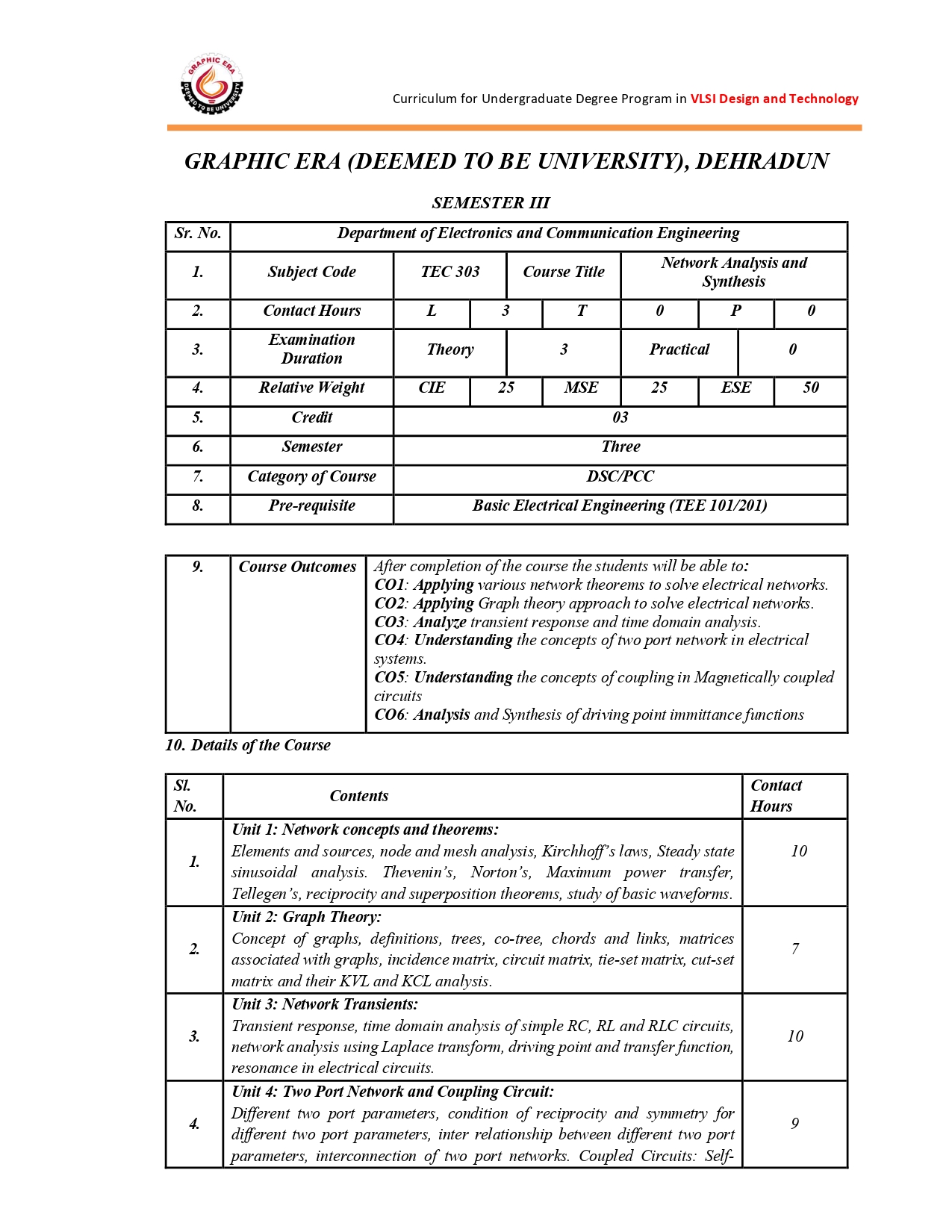
GRAPHIC ERA (DEEMED TO BE UNIVERSITY), DEHRADUN
SEMESTER III
|
Sr. No. |
Department of Electronics and Communication Engineering |
||||||||
|
1. |
Subject Code |
TEC 303 |
Course Title |
Network Analysis and Synthesis |
|||||
|
2. |
Contact Hours |
L |
3 |
T |
0 |
P |
0 |
||
|
3. |
Examination Duration |
Theory |
3 |
Practical |
0 |
||||
|
4. |
Relative Weight |
CIE |
25 |
MSE |
25 |
ESE |
50 |
||
|
5. |
Credit |
03 |
|||||||
|
6. |
Semester |
Three |
|||||||
|
7. |
Category of Course |
DSC/PCC |
|||||||
|
8. |
Pre-requisite |
Basic Electrical Engineering (TEE 101/201) |
|||||||
|
9. |
Course Outcomes |
After completion of the course the students will be able to: CO1: Applying various network theorems to solve electrical networks. CO2: Applying Graph theory approach to solve electrical networks. CO3: Analyze transient response and time domain analysis. CO4: Understanding the concepts of two port network in electrical systems. CO5: Understanding the concepts of coupling in Magnetically coupled circuits CO6: Analysis and Synthesis of driving point immittance functions |
10. Details of the Course
|
Sl. No. |
Contents |
Contact Hours |
|
1. |
Unit 1: Network concepts and theorems: Elements and sources, node and mesh analysis, Kirchhoff’s laws, Steady state sinusoidal analysis. Thevenin’s, Norton’s, Maximum power transfer, Tellegen’s, reciprocity and superposition theorems, study of basic waveforms. |
10
|
|
2. |
Unit 2: Graph Theory: Concept of graphs, definitions, trees, co-tree, chords and links, matrices associated with graphs, incidence matrix, circuit matrix, tie-set matrix, cut-set matrix and their KVL and KCL analysis. |
7 |
|
3. |
Unit 3: Network Transients: Transient response, time domain analysis of simple RC, RL and RLC circuits, network analysis using Laplace transform, driving point and transfer function, resonance in electrical circuits. |
10 |
|
4. |
Unit 4: Two Port Network and Coupling Circuit: Different two port parameters, condition of reciprocity and symmetry for different two port parameters, inter relationship between different two port parameters, interconnection of two port networks. Coupled Circuits: Self-inductance and Mutual inductance, Coefficient of coupling, dot convention, Analysis of Magnetic Coupling Circuits. |
9 |
|
5. |
Unit 5: Network Function and Synthesis: Driving point function, transfer function, Positive real function; definition and properties, poles and zeroes of network functions, Hurwitz polynomials, properties of LC, RC and RL driving point functions, synthesis of LC, RC and RL driving point admittance functions using Foster and Cauer first and second forms. |
9 |
|
|
Total |
45 |
11. Suggested Books
|
SL. No. |
Name of Authors/Books/Publishers |
Edition |
Year of Publication / Reprint |
|
|
Textbooks |
|
|
|
1. |
Kemmerly, Hayt and Durbin, “Engineering Circuit Analysis”, TMH. |
7th |
2010 |
|
2 |
Van Valkenburg, M.E., “Network Analysis & Synthesis”, PHI/ Pearson education. |
3rd |
2002 |
|
|
Reference Books |
|
|
|
1. |
Alexander, Charles K., Sadiku, Matthew N. O., “Fundamentals of Electric Circuits”, Mc-Graw Hill. |
5th |
2004 |
|
2 |
Irwin David J./ R.Mark Nelms, “Basic Engineering Circuit Analysis”, John Wiley. |
8th |
2013 |
|
12. |
Mode of Evaluation |
Test / Quiz / Assignment / Mid Term Exam / End Term Exam |
- Teacher: Dr.Ashish Kumar Singh
GRAPHIC ERA (DEEMED TO BE UNIVERSITY), DEHRADUN
SEMESTER
|
Sr. No. |
Department of Electronics and Communication Engineering |
||||||||
|
1. |
Subject Code |
TEC 304 |
Course Title |
Signals and Systems |
|||||
|
2. |
Contact Hours |
L |
3 |
T |
1 |
P |
0 |
||
|
3. |
Examination Duration |
Theory |
03 |
Practical |
0 |
||||
|
4. |
Relative Weight |
CIE |
25 |
MSE |
25 |
SEE |
50 |
||
|
6. |
Credit |
01 |
|||||||
|
6. |
Semester |
Three |
|||||||
|
7. |
Category of Course |
DC |
|||||||
|
8. |
Pre-requisite |
Basic Electrical Engineering (TEE 101/201), Engineering Mathematics I (TMA101) & II (TMA201) |
|||||||
|
9. |
Course Outcomes |
After completion of the course the students will be able to: CO1: Differentiate between various types of signals and understand the implication of operations of signals. CO2: Understand and classify systems based on the impulse response behaviour of both continuous time and discrete-time systems. CO3: Apply Fourier series for continuous-time signals. CO4: Apply Fourier Transform for continuous-time signals. CO5: Explain the Laplace transform and its importance to analyse signals and systems. CO6: Design and develop LTI systems and its response in time and frequency domain |
10. Details of the Course
|
Sr. No. |
Contents |
Contact Hours |
|
1. |
Unit 1: Introduction to Continuous-time and Discrete-time Signals: Introduction to signal, Classification of signals: continuous /discrete-time, Analog/ digital signal, Periodic/ aperiodic, Even/odd, Energy/power, Deterministic/random, Commonly used continuous-time signals and discrete-time signals: Unit step, Unit ramp, Exponential, Rectangular pulse, Unit impulse, Operation on continuous –time and discrete time signals: Addition, Multiplication, Differentiation/difference, Integration/ accumulation, Shifting, Scaling, Folding. |
10
|
|
2. |
Unit 2: Introduction to Continuous-time and Discrete-time Systems: Classification of systems: Static and dynamic, Linear, and non-linear, Time-variant and time invariant, Causal, and non-causal, Stable and unstable, Continuous time and discrete time LTI system, Impulse response and step response of LTI systems, Convolution integral/ convolution sum, Properties of LTI system. |
10 |
|
3. |
Unit 3: Fourier Series Analysis of Continuous-time Signals: Introduction, Vector space representation by ortho-normal vectors and signal space representation by orthogonal signal set, Fourier series representation of periodic signals, Convergence of Fourier series, Trigonometric Fourier series and exponential Fourier series, Properties of the continuous time Fourier series. Power content of a periodic signal. |
10 |
|
4. |
Unit 4: Continuous Time Fourier Transform: Deriving Fourier transform from Fourier series, Convergence of the Fourier transforms, Fourier transform of standard signals, Properties of Fourier transforms, Inverse Fourier Transform, Convolution, Parseval's theorem: Energy spectral density, Power spectral density. |
9 |
|
5. |
Unit 5 Laplace Transform: Introduction to Laplace transform, Relation between Laplace and Fourier transforms, Region of convergence for Laplace transform, Properties of ROC, Laplace transform of some common signals, Properties of the Laplace transform, Convolution, Unilateral Laplace transform, Inverse Laplace transform and initial value and final value theorem, Solution of differential equation using Laplace transform. |
9 |
|
|
Total |
48 |
11. Suggested Books
|
Sr. No. |
Name of Authors/Books/Publishers |
Edition |
Year of Publication / Reprint |
|
|
Textbooks |
|
|
|
1. |
Alan. V. Oppenheim, Alan. S. Willsky, and S. Hamid Nawab, “Signals and Systems”, Prentice-Hall, Inc. |
2nd |
2001 |
|
2. |
Simon Haykin, and Barry VanVeen, “Signals and systems”, John Wiley & Sons. |
2nd |
2007 |
|
3. |
P. RamaKrishna Rao and Shankar Prakriya, “Signals and Systems”, McGraw Hill Education Private Limited. |
2nd |
2013 |
|
|
Reference Books |
|
|
|
1. |
B. P. Lathi, “Signal processing and linear systems”, Oxford university press. |
1st |
2009 |
|
2. |
R.F. Ziemer, W.H. Tranter and D.R. Fannin, "Signals and Systems - Continuous and Discrete", Pearson New International Edition. |
4th |
2014 |
|
3. |
H. P. Hsu, “Signal and Systems”, McGraw Hill Publications. |
2nd |
2008 |
- Teacher: MD Irfanul Hasan
Unit 1: Bipolar Junction Transistor: Review of BJT, BJT as an amplifier and switch, Small signal models and analysis (CB, CE, CC), Frequency response of CE amplifier, Calculation of cut off frequencies, RC coupling. Multistage amplifier: Cascade amplifier, Darlington pair, Bootstrapping, and Cascode configuration.
Unit 2: MOSFET and MOS Capacitor: Introduction to FET, MOSFET or IGFET, DE MOSFET, E-only MOSFET, MOSFET characteristics, Q-point analysis. Introduction to MOS Capacitor, C-V Characteristics of MOS Capacitor, Mobility Models, Short Channel MOSFET I-V Characteristics, Control of threshold Voltage, Substrate Bias Effects, Subthreshold Characteristics.
Unit 3: MOSFET as an Amplifier: MOSFET biasing, MOSFET as an amplifier and switch, Biasing in MOSFET amplifier circuits, small signal models and analysis (Common Gate, Common Source, Common Drain). Frequency response of CS amplifier, Calculation of cut off frequencies.
Unit 4: Feedback Circuits and Oscillators: General feedback structure, Properties of negative feedback, Four basic feedback topologies and their analysis. Principle of sinusoidal oscillators, Types of oscillators: RC phase shift, Wein bridge, Hartley, Colpitts, Clapp and crystal oscillator. 9
Unit 5: Power Amplifiers: Introduction to power amplifier, Classification of power amplifier, Operation and efficiency of: Series fed class A, Transformer coupled class A, Class B push pull, Crossover distortion, Class AB push pull, Class C power amplifier.
- Teacher: KAUSHAL KUMAR
COURSE OUTCOMES
|
CO 1 |
Recall the concepts of computer system and its organization. |
|
CO 2 |
Understand different Computer Arithmetic operations and algorithms. |
|
CO 3 |
Understand different addressing modes and instruction formats. |
|
CO 4 |
Analyse memory organization, cache memory mapping and paging to improve performance. |
|
CO 5 |
Assess and evaluate processor organization and control unit. |
|
CO 6 |
Develop the concepts of computer organization for better understanding of courses, such as embedded system and robotics. |
Text Books:
1. William Stallings, Computer Organization & Architecture, PHI, 8th Edition.2010
2. Carl Hamacher, ZvonkoVranesic, SafwatZaky, Computer Organization, TMH, 5th Edition. 2002
Reference Books:
1. David A. Patterson, John L. Hennessy: “Computer Organization and Design – The Hardware / Software Interface ARM Edition”, Elsevier, 4th Edition, 2016
2. John P. Hayes,Computer Architecture and Organization, TMH, 3rd Edition. 2012
Course Plan
|
Lecture No. |
Learning Objectives |
Topics to be covered |
Reference Chap./Sec. (Book) |
|
1-5 |
Introduction of computer and generations.
|
Structure of a computer system, Functional components of a computer, Historical Development: First through Fourth Generation Computers, |
TB1,TB2 |
|
6-8 |
Computer models |
Moore’s Law, The Von Neumann and Non Von Neumann Model. |
TB1 |
|
9-11 |
Machine Instructions |
Memory location and addresses, Operands, Addressing modes, Instruction formats, Instruction Sequencing, |
TB2 |
|
12-14 |
Addressing modes |
Addressing Modes, Execution of a complete Instruction, Instruction set architectures - CISC and RISC architectures. |
TB2 |
|
15-17 |
Computer arithmetic |
Addition and subtraction, Arithmetic circuit, multiplication Algorithms, Division Algorithms |
TB1 |
|
18-20 |
Floating point arithmetic |
Floating-point representation, floating point Arithmetic operations, BCD Adder |
TB2 |
|
21-25 |
Processing Unit |
Organization of a processor - Registers, ALU and Control unit, Data path in a CPU, Instruction cycle, |
TB2 |
|
26-30 |
Organization of Control Unit |
Organization of a control unit - Operations of a control unit, Hardwired control unit, Microprogrammed control unit. |
TB2 |
|
31-35 |
Memory Organization |
Semiconductor memories, Memory cells - SRAM and DRAM cells, Internal Organization of a memory chip, Cache memory unit - Concept of cache memory, |
TB2 |
|
36-42 |
Memory Mapping |
Mapping methods, Organization of a cache memory unit, Effective Access Time and Hit Ratio, Virtual Memory, Paging, Advantages and Disadvantages of Paging. |
TB2 |
- Teacher: Sribidhya Mohanty